
In their academic article “Problematizing Cultural Difference: YouTube Narratives about COVID-19 by South Korean and American Vloggers,” discourse and linguistics scholars Jungyoon Koh and Anna De Fina challenge the validity of the concept of “cultural difference,” or the comparison between sweeping generalizations of cultural characteristics, using a bottom-up analysis of South Korean and American YouTube vlogs during the COVID-19 pandemic. Although analyses on cultural characteristics are still prevalent in the field of cultural studies, the authors critique this approach for its lack of nuance and its tendency to perpetuate stereotypes of nations or cultural groups. They contend that their qualitative analysis of COVID-19 vlogs produced in the two countries, combining a narrative as practices and multimodal discourse approach, reveals the intersection of sociocultural factors that shape pandemic experiences under different cultures and locations, as well as different communicative and storytelling practices, which contribute to “difference.”
From a sample of eight Korean and eight American vlogs, the authors found that the difference in pandemic response, specifically the strict quarantine regulations in Korea and the loose regulations in the US, played a major role in determining the topics that the vloggers covered. Korea’s COVID policy mandated all COVID-19 patients to isolate at treatment centers or hospitals, so the vloggers’ immediate surroundings, the medical care they received, and even the food provided at the treatment centers became prominent topics in Korean vlogs. In contrast, there was no such policy in the US, and patients were only required to self-isolate. US vloggers with COVID-19 described their symptoms more often to document the progression of their illness, such as one vlogger, Vanessa, who describes her loss of taste with “I can like taste the consistency of the peanut butter? But I can’t taste it. Let me see the blueberries… I can taste the tartness” (qtd. in Koh and De Fina 233). Food was also a common topic among US vloggers, but unlike Korean vloggers who documented food as part of their treatment experience, US vloggers displayed grocery shopping through delivery apps and food preparation as part of their new daily routine.
Communicative practices differed between US and Korean vloggers, although the differences were not fully attributable to regional differences. The authors found that the more popular a vlogger was, the more likely they were to make direct addresses to their audience. Most US vloggers generally had a larger following before the pandemic than the Korean vloggers, so US vloggers would provide advice to their audience and show vulnerability by discussing their emotions or mental health. Korean vloggers interacted with their audience in a less personal way, such as one vlogger, Dahee, who read and answered a question from her viewers, “If you’re asymptomatic do you really have no symptoms? What—what it’s like [to have COVID-19], is what you asked” (qtd. in Koh and De Fina 234), primarily focusing on the experience of being infected. From the sample of YouTube vlogs, the divergence in topics and contexts in which they are covered by the vloggers of both countries are not so much the result of shared national or regional characteristics, but instead the product of different national approaches to quarantine and the size of the vloggers’ existing following. The study provides substantive evidence to challenge the importance of cultural characteristics in shaping storytelling techniques, especially during pandemic times. Although YouTube vlogs existed for years prior to the pandemic, they proved to be a promising multimodal medium to record pandemic life as they combine verbal accounts, live footage from vloggers’ homes or surroundings, and interactions with the audience, which further enrich these lockdown narratives.
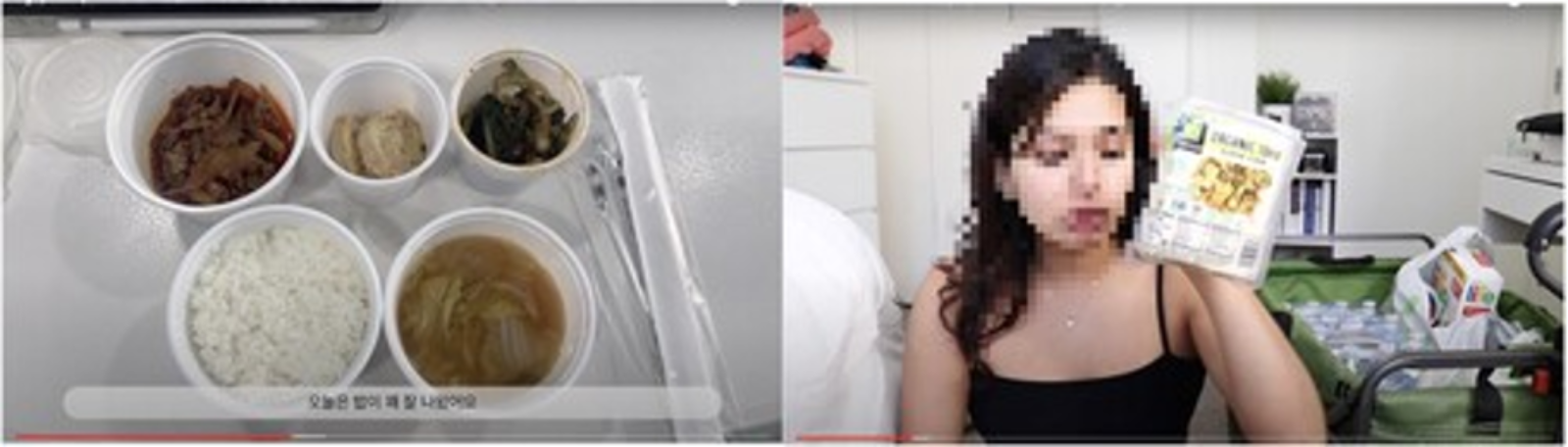
Image Captions:
Figure 1. How food is presented in a KR vlog (left) and in a US vlog (right). Via “Problematizing Cultural Difference: YouTube Narratives about COVID-19 by South Korean and American Vloggers” by Jungyoon Koh and Anna De Fina. Language and Intercultural Communication, vol. 24, no. 3, 22 Apr. 2023, pp. 222–240. https://doi-org.ezproxy.lib.torontomu.ca/10.1080/147084772.2023.2186422.Citation: Koh, Jungyoon, and Anna De Fina. “Problematizing Cultural Difference: YouTube Narratives about COVID-19 by South Korean and American Vloggers.” Language and Intercultural Communication, vol. 24, no. 3, 22 Apr. 2023, pp. 222–240. https://doi-org.ezproxy.lib.torontomu.ca/10.1080/14708477.2023.2186422. NON-FICTION, SCHOLARLY ARTICLE | KOREA, US. ll
Source Type: Scholarship on COVID-19 Studies
Country: South Korea and US
Date: 22-Apr-2023
Keywords: Communicative Practices, Cultural Difference, Illness Narratives, Multimodal Discourse Analysis, Pandemic Regulations, Vlogs, and Youtube