
Arshi Irshad Ahmadzai is a visual artist whose practice moves between image, text, and symbolic systems to examine questions of memory, language, and existence. When India entered lockdown in March 2020, Ahmadzai was stranded at her parents’ home in Najibabad, Uttar Pradesh, separated from her husband in Kabul. Over ten months she wrote 120 letters to him on pieces of manjarpat, a hard-wearing cotton cloth dyed with pigments from roses and carnations in her mother’s garden, using a qalam (bamboo reed pen) whose ink soaked into the fabric and at times blurred into “a dark puddle” where words dissolve into pure feeling. Nafas (2021), structured as a collection of unsent letters, explored vulnerability, longing, and the private language of intimacy. Across these works, text and image coexist in layered ways, sometimes resembling fragments of personal diaries, and at other times evoking the texture of ancient manuscripts.
The work selected here, Dil… Meer, Ghalib, Iqbal, Faiz, Faraz-o-Jaun ki Zubani (The Heart..The Voices of Meer, Ghalib, Iqbal, Faiz, Faraz, and Jaun) dated 29 August 2020, transcribes six ghazals about the heart by six major Urdu and Persian poets—arranged in vertical columns on cloth, each with a disembodied, perambulatory anatomical heart at the bottom. Together the six poems trace an arc from suffering through defiance to exhausted resignation, mapping the emotional geography of quarantine through three centuries of verse.
Meer Taqi Meer opens the sequence with incurable heartbreak: “ulTī ho ga.iiñ sab tadbīreñ kuchh na davā ne kaam kiyā / dekhā is bīmāri-e-dil ne āḳhir kaam tamām kiyā” (Stratagems all came apart, no cure could render remedy / it was this ailment of my heart, that finished me off finally). In a pandemic that defeated every strategy of containment, Meer’s eighteenth-century vocabulary acquires a literal second register. His closing couplet mirrors the flattened, cyclical time of quarantine: “raat ko ro ro sub.h kiyā yā din ko juuñ tuuñ shaam kiyā” (Bring in the dawn, crying all night, spend dawn to dusk in agony).
Mirza Ghalib answers with defiant vulnerability: “dil hī to hai na sañg-o-ḳhisht dard se bhar na aa.e kyuuñ / ro.eñge ham hazār baar koī hameñ satā.e kyuuñ” (It’s just a heart, no stony shard; why shouldn’t it fill with pain / I will cry a thousand times, why should someone complain?). Where Meer succumbs, Ghalib insists on the right to feel, and equates life itself with imprisonment: “qaid-e-hayāt o band-e-ġham asl meñ donoñ ek haiñ / maut se pahle aadmī ġham se najāt paa.e kyuuñ” (Prison of life and sorrow’s chains in truth are just the same / then relief from pain, ere death, why should man obtain).
Muhammad Iqbal shifts the register upward, from private suffering to transcendent utterance: “dil se jo baat nikalti hai, asar rakhti hai / par nahīñ, taaqat-e-parwaaz magar rakhti hai” (When passion streaming from the heart turns human lips to lyres / some magic wings man’s music then, his song with soul inspires). For Iqbal the heart’s anguish is not merely endured but launched skyward—”aasman cheer gaya nala-e-bebaak mera” (Before its daring swiftly fell the ramparts of the skies)—turning lockdown grief into an argument for the transformative power of speech.
Faiz Ahmed Faiz brings the sequence back to intimate address, but now sharpened by political longing: “kab tak dil kī ḳhair manā.eñ kab tak rah dikhlāoge / kab tak chain kī mohlat doge kab tak yaad na aaoge” (How long should I be grateful to my heart for its patience, how long will you make me wait / how long will there be peace; how long will I not remember you?). Read during the pandemic, the beloved whom Faiz awaits becomes indistinguishable from normalcy itself.
Ahmad Faraz’s contribution is the most nakedly desperate—an invitation to return even if only to inflict pain: “ranjish hī sahī dil hī dukhāne ke liye aa/ aa phir se mujhe chhoḌ ke jaane ke liye aa” (Even if you are annoyed, come just to give me pain / come even if you have to then leave me yet again). The closing couplet collapses hope and extinction into a single breath: “ab tak dil-e-ḳhush-fahm ko tujh se haiñ umīdeñ / ye āḳhirī sham’eñ bhī bujhāne ke liye aa” (My heart is optimistic yet, its hopes are still alive / come to snuff it out, let not this final flame survive).
Jaun Elia closes the sequence in a register of exhausted stillness: “dil kī taklīf kam nahīñ karte ab koī shikva ham nahīñ karte” (We do not lessen the pain of our heart / now we do not make any complaints). Where Meer wept, Ghalib protested, Iqbal soared, Faiz waited, and Faraz begged, Jaun simply stops: “jurm meñ ham kamī kareñ bhī to kyūñ / tum sazā bhī to kam nahīñ karte” (Why should we even reduce our faults / when you too do not reduce the punishment). It is the silence after the last lockdown curfew announcement—complaint itself has been used up.
Ahmadzai has described the role of Urdu in the project as involuntary and intimate: “The Urdu language is an undercurrent of my bloodstream, like quiet streaks. It discreetly made its way into my work, and if I complain, it laughs a silent, solemn laugh.” The literary references running throughout Nafas also include Lal Ded, Rabia Basri, Rumi, T. S. Eliot, Virginia Woolf, Hermann Hesse, and Dostoevsky, placing the series within a consciously transnational literary frame. This entry matters for the archive because it is pandemic life writing in its most material form—cloth that carries the scent of a particular garden, the stain of a particular rain, and the script of a language whose cultural erasure in contemporary India gives these letters an additional political charge.”
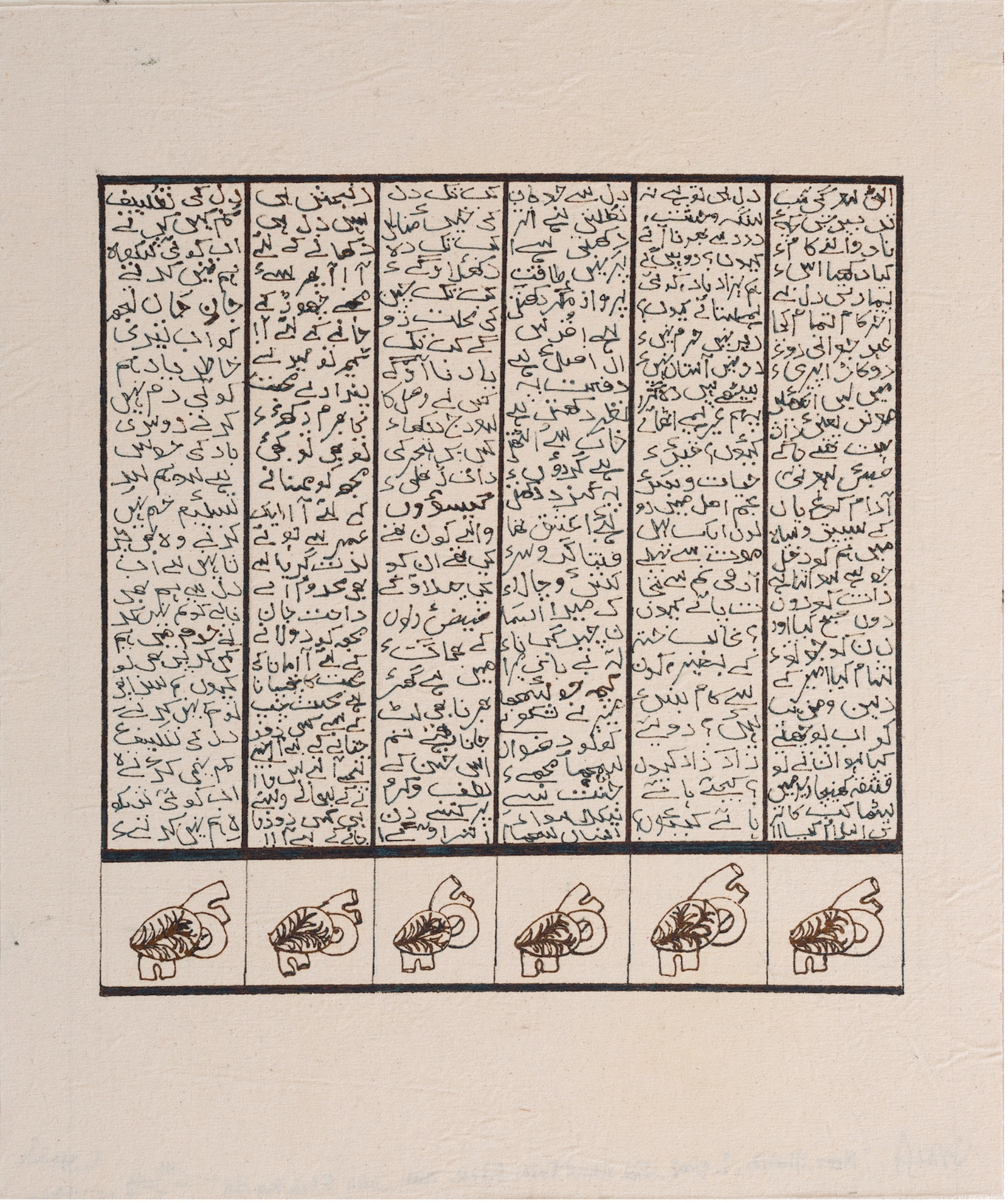
Image Captions:
Image of Dil… Meer, Ghalib, Iqbal, Faiz, Faraz-o-Jaun ki Zubani (The Heart..The Voices of Meer, Ghalib, Iqbal, Faiz, Faraz, and Jaun) 46×40 cm Ink on Manjarpat Fabric 2020. Arshi Irshad Ahmadzai. Nafas: Isolation Diaries, Blueprint 12, 2021. Image courtsey: Artist and Blueprint.12Citation: Ahmadzai, Arshi Irshad. “Dil… Meer, Ghalib, Iqbal, Faiz, Faraz-o-Jaun ki Zubani” (The Heart..The Voices of Meer, Ghalib, Iqbal, Faiz, Faraz, and Jaun). Nafas: Isolation Diaries, Blueprint 12, 2021. Ink on manjarpat fabric, 29 Aug. 2020. VISUAL ART, LIFE WRITING | INDIA, AFGHANISTAN. ll
Source Type: Visual Art
Country: India and Afghanistan
Date: 29-Aug-2020
Keywords: Calligraphy, Ghazal, India, Lockdown Art, Pandemic Life Writing, Textile Art, and Urdu