
In his study “Pandemic and Poetry: How Writers in Pakistan React to COVID-19,” Urdu ghazal poet and Vienna University scholar Aftab Husain surveys how writers in Pakistan responded to the first weeks of COVID-19, situating their outpouring within a long literary history of catastrophe. He opens with the Persian and Urdu proverb that “a collective death has an air of festivity,” arguing that calamity binds people together more than celebration does. An anecdote about the classical poet Mirza Ghalib follows: having foretold his own death, Ghalib survived the epidemic that struck Delhi that year and joked that a common death would have demeaned him. This framing anchors the contemporary response in a tradition where poets have long been the first witnesses to collective upheaval.
The corpus is twofold. Husain first invokes a canon of plague writing—the novelists Albert Camus, Gabriel García Márquez, and José Saramago—alongside the South Asian literary tradition of Rabindranath Tagore, Munshi Premchand, and Ahmed Ali’s Twilight in Delhi. He then assembles a fresh archive of contemporary Pakistani poems composed during lockdown and analyses them through comparative close reading, grouping them by sensibility. A comic vein, exemplified by Tahir Sherazi’s poem “Thanks,” frames confinement as a chance to repair family bonds, though Husain faults it for ignoring the domestic burden placed on women: the male poet schemes of leisure while his spouse carries on with her routine domestic chores. A devotional vein reads the virus as divine wrath, while a secular counter-vein, typified by Maqsood Wafa’s “The Captive Days,” insists that “when a virus attacks a human being / It doesn’t ask the name of his god.” Husain also collects ghazal couplets that distil the mood of quarantine and severed human contact, among them Mahmood Shaam’s aphoristic line: “What a weird malady is it whose cure lies in solitude!” The study’s significance is that it documents and evaluates an emergent pandemic literature as it was being written, separating durable art from what Husain calls mere “pièce d’occasion.” He argues that even the slighter poems bear witness to a momentous event and have, in his phrase, “transcribed these times on the climate of our minds.” The article fills a gap in the archive by representing the Urdu literary tradition’s response to COVID-19, a tradition in which pandemic poetry has precedent stretching from Ghalib’s Delhi in 1857 to the ghazal couplets circulating on Pakistani social media in the spring of 2020.
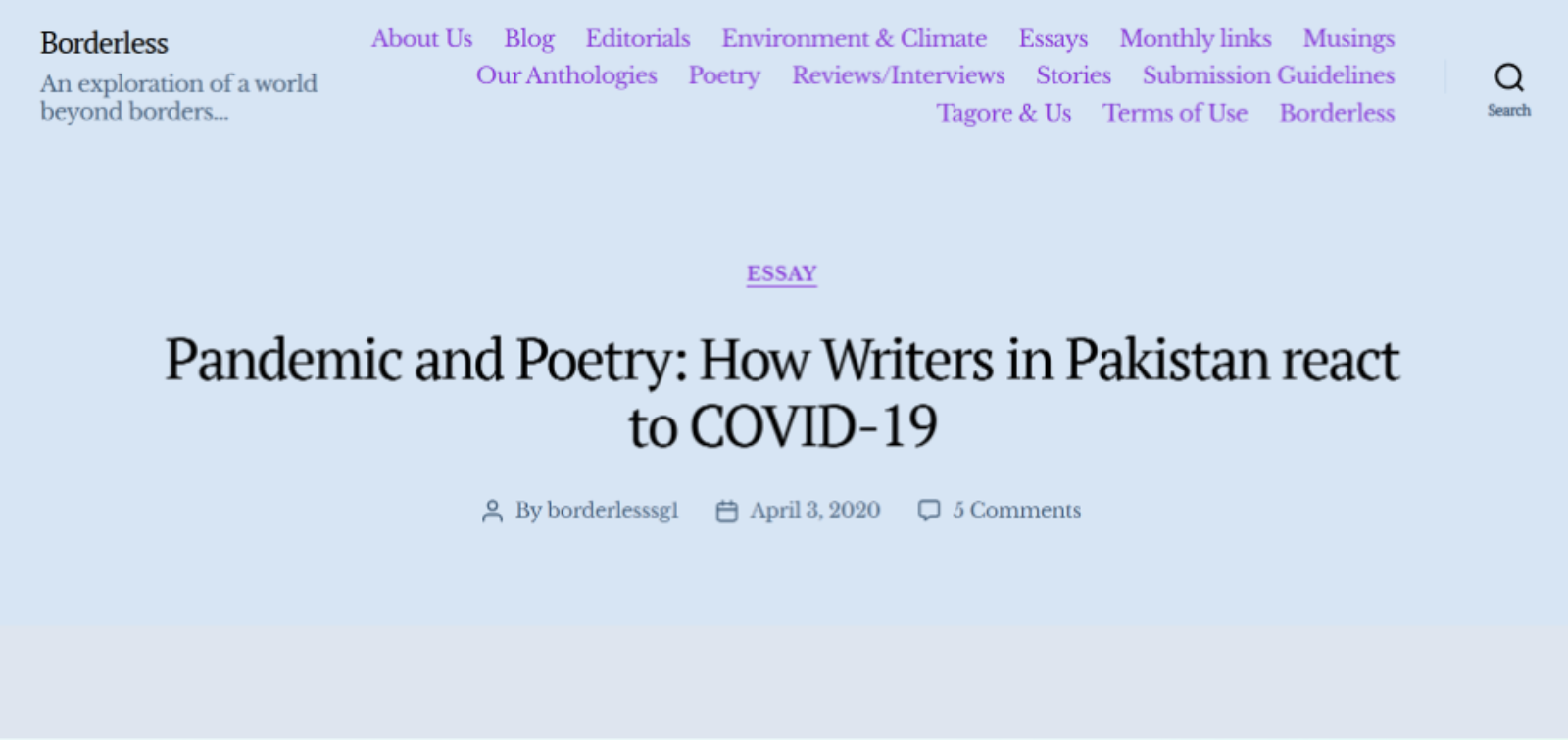
Image Captions:
Screenshot of “Pandemic and Poetry” by Aftab Husain. Borderless, 3 Apr. 2020.Citation: Husain, Aftab. “Pandemic and Poetry: How Writers in Pakistan React to COVID-19.” Borderless, 3 Apr. 2020, bit.ly/4hX5HgO. Accessed 7 July 2026. NON-FICTION, SCHOLARLY ARTICLE | PAKISTAN. ll
Source Type: Scholarship on Pandemic Studies
Country: Pakistan
Date: 03-Apr-2020
Keywords: COVID-19 Poetry, Ghazal, Pakistan, Pandemic Literature, and Urdu Literary Tradition