
In her essay “The Pandemic Is a Portal,” Booker Prize-winning novelist and political essayist Arundhati Roy, argues that COVID-19 is not merely a public-health emergency but a historical rupture that lays bare the structural violence of inequality in India and beyond. Written during the first week of India’s lockdown, the essay recounts how Prime Minister Narendra Modi confined 1.38 billion people with four hours’ notice, and how the mass expulsion of migrant workers, stripped of wages and public transport, forced millions to walk hundreds of kilometres toward their home villages. Roy reframes the catastrophe as an opening, calling the pandemic “a portal, a gateway between one world and the next,” through which humanity can either drag its accumulated prejudice and hatred or pass lightly, “ready to imagine another world.”
The corpus Roy analyses is the unfolding present itself: Modi’s televised addresses, the scenes she witnessed at the Delhi border after using a press pass to reach Ghazipur, and the media’s pandemic coverage. Her method is literary reportage fused with political argument, braiding eyewitness detail with historical reflection. She reads the lockdown as an experiment that illuminates what a society conceals, exposing caste, class, and a global capitalism the virus has briefly halted. Roy records how the Indian mainstream media absorbed the outbreak into what she describes as a continuous toxic anti-Muslim campaign, scapegoating the Tablighi Jamaat and insinuating that Muslims had spread the disease deliberately. She situates this scapegoating within India’s longer history of communal violence, arguing that the pandemic became a pretext for a persecution whose roots predate the virus by decades.
The essay’s significance lies in its early, globally circulated framing of the pandemic as a chance for radical re-imagination rather than a return to a broken normal. It anchors a central South Asian critical perspective and connects directly to the anti-Muslim scapegoating that Manan Ahmed Asif analyses in the same period. Roy insists that the way we narrate this rupture, and who we choose to blame or protect, will determine the world that emerges from it.
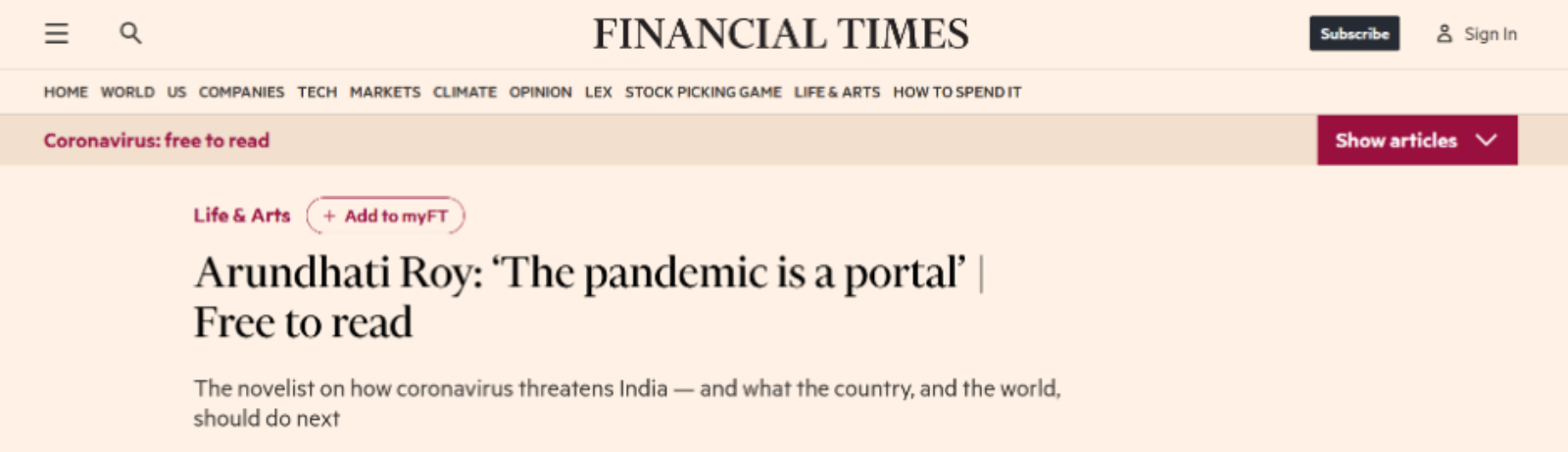
Image Captions:
Screenshot of “The Pandemic Is a Portal” by Arundhati Roy. Financial Times, 3 Apr. 2020.Citation: Roy, Arundhati. “The Pandemic Is a Portal.” Financial Times, 3 Apr. 2020, bit.ly/3TJuqLH Accessed 7 July 2026. NON-FICTION, ESSAY | INDIA. ll
Source Type: Scholarship on Pandemic Studies
Country: India
Date: 03-Apr-2020
Keywords: COVID-19 in India, Inequality, Lockdown, Migrant Workers, and Political Essay